
South African businesses are under pressure. Load-shedding may be easing, but margins remain tight, competition is fierce, and everyone is talking about AI. CEOs hear promises of 20–30% productivity gains and ask their teams to “implement Copilot” or “get us on Fabric.”
Six weeks later, many discover the outputs are inconsistent, the team doesn’t trust them, and compliance teams start asking difficult questions about data sources.
A recent Gartner survey of over 350 D&A and AI leaders drives this home: organisations with successful AI initiatives invest up to four times more (as a percentage of revenue) in data quality, governance, context foundations, and change management than those seeing poor results. Only 39% of leaders feel confident their current AI spend will improve financial performance.
This is not a technology problem. It is a foundation problem.
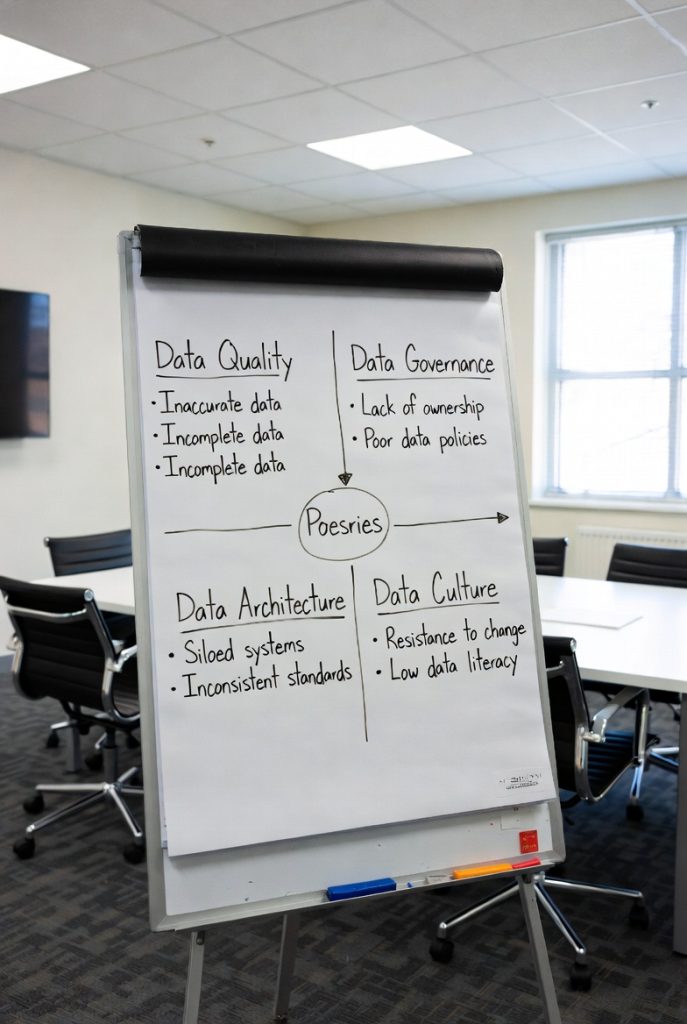
The business problem most SA mid-market companies face You probably run on a mix of Excel, disconnected ERP/CRM systems, and a few Power BI dashboards that “sort of” work. Data lives in silos. Definitions differ between finance and operations (“What exactly is a ‘sale’?”). Governance is manual or absent. When you point Copilot or an agent at this environment, it reflects the mess back at you — faster.
What has changed Microsoft is making the platform pieces easier. The May 2026 Power BI updates include visual calculations that reduce DAX complexity, better exploration perspectives for large models, and OneLake now has production-ready row- and column-level security. Fabric continues to mature with stronger governance tools. But these features only deliver value on top of clean, governed data.
Practical explanation Think of your data estate like a building. AI tools are powerful new lifts and smart lighting. If the foundation has cracks and the wiring is exposed, the fancy additions create more problems than they solve.
- Trusted data: Consistent, quality-checked sources with clear lineage.
- Semantic context: A well-designed tabular model (in Power BI or Fabric) that defines business logic once and reuses it everywhere.
- Governance: Who can see what, audit trails, sensitivity labels, and dynamic masking for POPIA compliance.
- People and process: Training, change management, and clear ownership.
Companies that treat these as afterthoughts waste money. Those that invest here see compounding returns — better reporting today, reliable AI tomorrow.
What companies should do next
- Run a quick data maturity assessment (focus on quality, consistency, and access).
- Prioritise one or two high-value domains (e.g., finance close or supply chain) and build proper semantic models.
- Implement basic governance — even workspace-level controls and sensitivity labels make a difference.
- Test AI features only after the foundation is solid enough for reliable answers.
- Measure business outcomes, not just model accuracy.
How Ialytics can help
We have done this dozens of times for South African businesses moving off Excel and fragmented systems. We build practical, maintainable data models in Power BI, SSAS, or Fabric. We implement governance that fits mid-market realities and budgets. And we focus on outcomes — faster, trusted insights that support better decisions and prepare you for AI without the regret.
If your team is being asked to “do AI” but the basics still hurt, let’s talk. A short workshop can show exactly where your gaps are and what fixing them unlocks.
The companies winning with data and AI in South Africa are not the ones with the biggest budgets. They are the ones who built the quiet foundations first.